
How Automation Cuts Operational Costs in Manufacturing & Retail
Practical automation use cases for plants and retailers, realistic ROI expectations and what to prepare before you build.
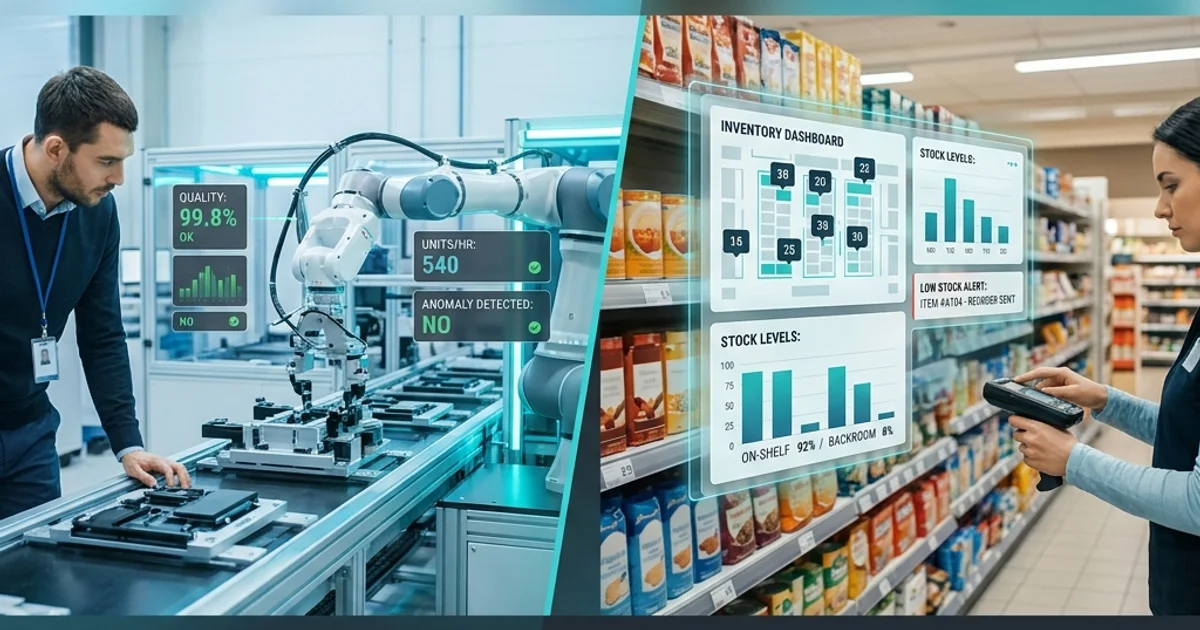
Useful automation does not look like science fiction, it looks like a system that reads supplier invoices, flags inventory about to run out, or routes support queries without a human dispatcher. This guide covers practical applications for manufacturing and retail, with realistic expectations on outcomes and cost.
Where plants usually save first
Predictive maintenance
Sensors feed models that flag machines before unplanned downtime. Unplanned downtime typically costs 5-20× more than planned maintenance. A system that cuts unplanned downtime by ~20% often pays for itself within 12-18 months in mid-size facilities.
Quality inspection
Computer vision inspects line output faster and more consistently than sample-only human checks. Defect detection of 95-99% is achievable for visual defects on standardized products, proven tech at accessible price points above roughly 10,000 units/month.
Demand forecasting
Models that blend history, seasonality, and market signals usually beat spreadsheet planning. Typical lift: 15-30% less excess inventory while holding or improving service levels.
Where retailers usually save first
Intelligent document processing
Purchase orders, invoices, and delivery notes are extracted, validated, and posted into your system of record. A mid-size retailer processing 500-2,000 invoices/month can remove 80-90% of re-keying, often within ~60 days of deployment.
Inventory optimization
Dynamic reorder points account for lead times, demand variability, and stockout cost, not static safety-stock formulas. Retailers often see 10-25% inventory reduction without more stockouts.
Customer service assistants
Controlled bots handle tier-1 queries (order status, returns, product FAQs). Structured traffic often resolves 40-60% automatically, freeing agents for complex cases.
What automation cannot fix (yet)
It will not replace clean data, clear processes, or judgment on novel situations. Models built on poor data automate bad decisions at scale. Invest in data quality and process clarity before you invest in models.
Getting started
Pick one measurable use case where data already exists, invoice processing, forecasting, or inspection are strong first projects. They are contained and do not require a full org transformation.
Talk to our team about which use case fits, or try the implementation ROI planner. We offer a free half-day assessment for manufacturing and retail teams.
- document intelligence
- manufacturing
- retail
- predictive maintenance
- process automation
Have questions about Automation?
Talk to our team, estimate ERP impact with the ROI calculator, or browse business solutions.